What changes the decision
Write a two-part requirement: battery-test voltage and cranking/charging-system voltage. That prevents a broad 12/24V badge from hiding an unsupported battery test.
Separate the questions
| Your intended job | Capability to verify | Do not substitute |
|---|---|---|
| Battery-health test on a 12V battery | 12V battery testing plus correct chemistry | A general 24V system label |
| Cranking/charging on a 24V system | Explicit 24V support for each system function | 12V-only system testing |
| Battery-health test on actual 24V battery | Explicit actual 24V battery-test support | 12V battery + 24V system coverage |
A concrete manufacturer example
The BT200 page describes 12V battery testing alongside 12V/24V system tests. Treat that as separate coverage, not permission to run battery-health testing across 24V. Marketing headings can be broader than the function-specific requirement you need.
Primary source: TOPDON USA: BT200 published specifications
Individual testing is a manual-controlled procedure
The MDX-655P manual includes a 24-volt-system message with instructions for individual battery testing. That instruction is specific to its workflow. This article does not provide a universal series-bank disconnection sequence; vehicle and device manuals or a qualified technician must determine the procedure.
Primary source: Midtronics MDX-655P official manual
Two Finder paths that must stay separate
Choose the 12V-battery-with-24V-system path when that describes the actual job. Choose actual 24V battery testing when it is the battery-health requirement itself. If no verified tool fits, the requirement should remain visible rather than being automatically relaxed to an affiliate product.
Battery Tester Match editorial interpretation, not a manufacturer verdict or remote fault diagnosis.
Choose the next step
Find tools for 12V batteries and 24V system checks →This is the combined-system path only. Use the linked 24V buying guide if you need actual 24V battery testing.
Compare actual 24V battery and 24V system tool paths →A practical check sequence
- Read the nominal voltage of the specific battery being assessed, then separately identify the vehicle-system voltage. Do not treat the series-bank total as the rating of each battery.
- For actual24V battery-health testing, require explicit support for that function. BT200-style12V battery/24V system coverage does not satisfy it.
- If a manual calls for individual testing in a bank, obtain the vehicle-specific procedure or professional help. This article does not substitute a generic isolation sequence.
Choose by the battery and system voltages separately
Buying a tester is optional. First identify the unanswered check and follow the battery, vehicle and instrument manuals. These are capability examples, not a performance ranking or a substitute for inspection.
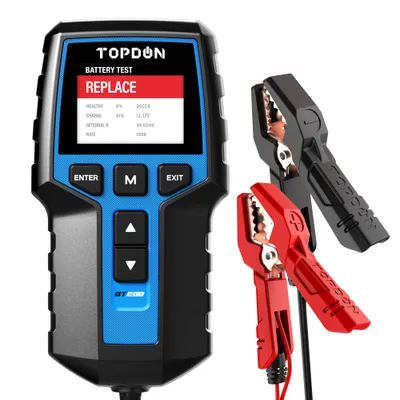
TOPDON BT200
12V batteries; 12/24V systems. Conductance.
12V battery + 12V/24V system testing. Skip this model if your required voltage, chemistry, test method or reporting output is absent from its specification.
View capabilities and limitations →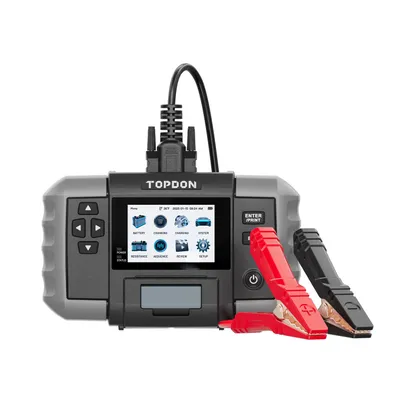
TOPDON BT600 Plus
6/12/24V batteries; 12/24V systems. Conductance.
Pro 6V/12V/24V battery + printer/resistance. Skip this model if your required voltage, chemistry, test method or reporting output is absent from its specification.
View capabilities and limitations →Related questions
Sources and checked date
Sources checked:
- TOPDON USA: BT200 published specifications
12V battery testing versus 12V/24V cranking and charging system coverage
- Midtronics MDX-655P official manual
Battery-test setup and model-specific decision messages, pp. 11–12; system tests, pp. 13–14
This is a source-based explanation, not our hands-on testing. Capabilities do not establish merchant availability, price or vehicle compatibility. Stop work and seek qualified help if leakage, swelling, unusual heat, odor or smoke is present.
Read both voltage fields before choosing
Support for a 24V vehicle system does not prove support for testing an actual 24V battery. The Finder keeps the two requirements separate. Read the real battery arrangement and official manual rather than deriving it from the vehicle category.
Figure out what you need to test
Start with what happened and what you need to check. You may already have a suitable tool, or prefer to have a shop inspect the car.
See what to check →If you need equipment
Battery health — Choose the link to see matching testers. You can change or clear these filters at any time.
Show matching testers →