What changes the decision
Start with when the problem happens. A slow start and a battery that goes flat again can call for different checks. Choose the needed functions rather than relying on a generic “battery tester” label.
Separate the questions
| Question | Function to confirm | Limit |
|---|---|---|
| What happens during engine starting? | Cranking / starting test | Not a full mechanical starter diagnosis |
| What happens while the charging system operates? | Charging-system test | Not proof of every intermittent electrical fault |
| What is the battery’s condition? | Battery-health test | Does not automatically include either system test |
Manufacturer coverage is function-specific
TOPDON labels the BT200 as a 12V battery and 12V/24V system tester. That coverage separates battery voltage from system voltage; it should not be shortened to “24V battery tester”. Confirm each function in the specifications before using it.
Primary source: TOPDON USA: BT200 published specifications
Test order and conditions still matter
The MDX-655P manual says starting and charging-system performance depends on battery condition. Follow the specific device and vehicle instructions for prerequisites; do not interpret a system reading as independent of an undercharged or failing battery.
Primary source: Midtronics MDX-655P official manual
What changes the equipment shortlist
Battery-only is enough only when battery health is the question. Add cranking for starting-event evidence and charging for charging-system evidence. Reporting needs are a separate workflow choice. An affiliate relationship cannot turn an unsupported function into verified capability.
Battery Tester Match editorial interpretation, not a manufacturer verdict or remote fault diagnosis.
Choose the next step
Find a tester with both system tests →The prefill requests test functions; set the actual battery and system voltage separately.
Compare battery and alternator tester capabilities →A practical check sequence
- Write down when the complaint occurs: while the engine is turning over, while driving, or after parking. Those are not interchangeable test requirements.
- Check the manual’s prerequisites for a starting or charging test. A weakly charged battery can affect system observations; do not bypass the prescribed battery check.
- Only request the needed function and voltage. Charging-system coverage is not a parked-current investigation or a guarantee that the alternator is the failed part.
Match the tool to the system you need to check
Cranking and charging answer different questions. Select both only when your remaining question calls for them, and keep system voltage separate from battery-test voltage.
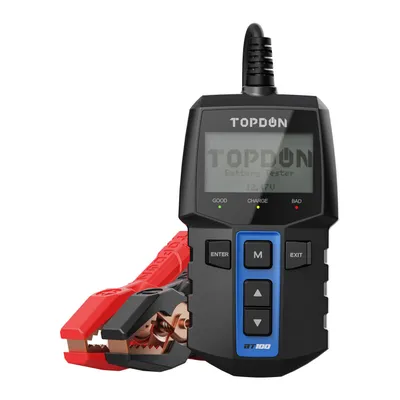
TOPDON BT100
12V batteries; 12V systems. Conductance.
For supported12V battery, cranking and charging checks. Does not meet a24V system requirement.
View capabilities and limitations →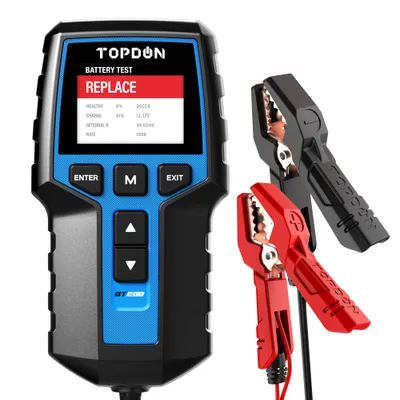
TOPDON BT200
12V batteries; 12/24V systems. Conductance.
Adds documented24V system coverage when that is genuinely required. Still a12V battery-health tester;24V system support is not actual24V battery analysis.
View capabilities and limitations →Related questions
Sources and checked date
Sources checked:
- TOPDON USA: BT200 published specifications
12V battery testing versus 12V/24V cranking and charging system coverage
- Midtronics MDX-655P official manual
Battery-test setup and model-specific decision messages, pp. 11–12; system tests, pp. 13–14
This is a source-based explanation, not our hands-on testing. Capabilities do not establish merchant availability, price or vehicle compatibility. Stop work and seek qualified help if leakage, swelling, unusual heat, odor or smoke is present.
Match the symptom to the check, not to a guessed part
Slow starting calls for a starting check. A battery that keeps going flat may also need charging-system or other vehicle checks. A combined tester covers only its documented functions. It does not establish a complete diagnosis of parked electrical drain.
Match the symptom to the test you need
Slow starting and repeated discharge can lead here for different reasons. This guide defines the test functions; the symptom pages help identify what happened before you choose one. Neither the symptom nor the selected function names a failed component.
| Observed complaint | Function question | Unresolved limit |
|---|---|---|
| Engine rotates slowly during starting | Is battery plus cranking coverage documented? | Not a complete diagnosis of the starter or cables |
| Battery becomes flat again after parking or charging | Which battery and system checks have actually been performed? | A combined tester does not establish a parked-drain investigation |
| GOOD battery report, symptoms remain | Does the report include the relevant system test? | Do not dismiss recurring symptoms because one test passed |
Midtronics MDX-P300 specifications — Separate battery, starting and charging functions. The symptom-to-question map is editorial reasoning and does not certify a fault or every tester model. Checked:
Figure out what you need to test
Start with what happened and what you need to check. You may already have a suitable tool, or prefer to have a shop inspect the car.
See what to check →If you need equipment
Battery + cranking + charging — Choose the link to see matching testers. You can change or clear these filters at any time.
Show matching testers →