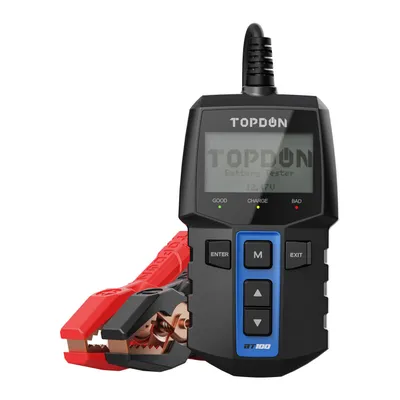
TOPDON BT100
12V batteries; 12V systems. Conductance.
A handheld 12V battery and cranking check when you do not need a printed handoff. Not an actual24V battery tester, a printer or a physical load test.
View capabilities and limitations →Problem → test requirement → right tool
Slow cranking is a symptom, not a battery replacement verdict. Battery-health and cranking checks provide different context, and persistent symptoms may need vehicle-side inspection.
| Situation | What matters | Next check |
|---|---|---|
| Slow crank with no battery report | Condition of the battery is not yet documented | Identify battery-health and starting-event requirements separately |
| GOOD battery report, but the engine still turns slowly | A battery assessment and a cranking observation are not the same test | Check documented cranking coverage or arrange vehicle-side inspection |
| Only a resting-voltage reading is available | A measurement taken before starting does not describe the starting event | Record when the voltage was measured; it does not diagnose the battery or starter by itself |
| Problem is flatness after parking, not slow rotation | The symptom belongs to a different question | Use the repeated-discharge article rather than automatically buying cranking capability |
Choose battery plus cranking capability when the question includes starting behavior; do not treat a resting voltage or a GOOD battery label as a complete starting-system assessment.
The following is our editorial interpretation, not a remote fault diagnosis or hands-on test report.
This page concerns an engine turning more slowly than usual during starting. A no-crank complaint or a battery found flat after parking is a different description; do not silently treat all three as the same job. Note whether the slow rotation is repeatable and what charging or battery replacement preceded it. These observations support a technician’s assessment, not a remote parts diagnosis.
The MDX-655P manual presents battery, starter-system and charging-system tests separately. A resting-voltage observation has its own conditions; it does not describe what happened while starting. Use your actual instrument’s manual to identify which test produced each result, rather than interpreting every displayed voltage as the same evidence.
If your remaining question is starting behavior, the proposed Finder requirement is battery plus cranking. Charging, printer and app features are separate choices. Confirm the supported chemistry and both voltage fields; 24V system coverage does not establish actual 24V battery testing. Persistent symptoms can still justify inspection rather than a tool purchase.
Temperature, battery design and the vehicle’s specifications change interpretation; this checklist provides no universal voltage limit. If the equipment, access or safety conditions are unfamiliar, have a technician perform the checks.
TOPDON BT100 official manual: setup and precautions · Check the measuring setup
A slow crank can involve the battery or the starting system. If you choose to measure, keep battery health and cranking capability together; persistent symptoms can still need vehicle inspection.
12V batteries; 12V systems. Conductance.
A handheld 12V battery and cranking check when you do not need a printed handoff. Not an actual24V battery tester, a printer or a physical load test.
View capabilities and limitations →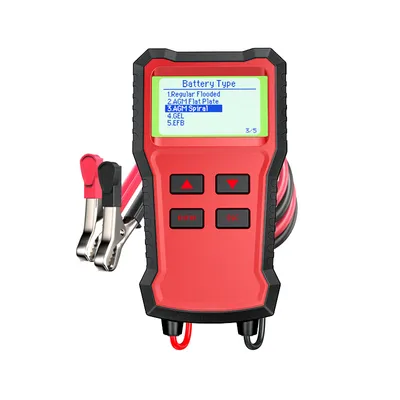
12V batteries; 12V systems. Electronic analyzer.
A non-affiliate example with battery, cranking and charging capability; its fit does not depend on a purchase partnership. Confirm the supported chemistry and rating; no approved affiliate merchant is listed.
View capabilities and limitations →Start with what happened and what you need to check. You may already have a suitable tool, or prefer to have a shop inspect the car.
See what to check →Battery + cranking — Choose the link to see matching testers. You can change or clear these filters at any time.
Show matching testers →Battery conductance and starting/charging system tests are separate functions. Not a product recommendation.
Correct battery type/rating and measurement context; not a universal replacement threshold.
Model-specific battery decisions on printed page 12 and separate starter/charging tests on pages 14–15. Not a verdict dictionary for other testers.
Follow the vehicle, battery and equipment manuals. Stop work for leakage, swelling, unusual odor, heat or smoke. A battery-test voltage rating is not a vehicle-system voltage rating.