What changes the decision
Before shopping, identify what your required procedure actually measures. A tool producing a CCA estimate cannot be substituted automatically when the procedure requires a true applied-load test.
Separate the questions
| Method | Useful evidence | Limit to keep visible |
|---|---|---|
| Conductance | Fast starting-capability estimate with compatible inputs | Not proof that a specified carbon-pile load was applied |
| Applied-load / carbon pile | Battery response to the prescribed load | Procedure, battery type and conditions must be suitable |
| Reserve-capacity evaluation | Ability to support loads over time | Not established by an ordinary CCA number alone |
What the manufacturer distinguishes
Midtronics describes conductance, reserve-capacity evaluation and charge acceptance as distinct technologies. Its explanation supports separating the questions, not treating every digital analyzer as having all three capabilities.
Primary source: Midtronics: Which battery test technology is right for you?
Why a label is weaker evidence than a procedure
“Digital load tester” may be retail wording rather than a method description. Look for the manufacturer’s actual test method and operating instructions. If a workshop or battery warranty requires a specific procedure, follow that requirement rather than replacing it with a convenient-looking result.
Battery Tester Match editorial interpretation, not a manufacturer verdict or remote fault diagnosis.
Compare testers after choosing the test method
Once you know which method your procedure requires, compare testers with that documented capability. If you select true load testing in the Finder, conductance testers will not be substituted automatically.
Battery Tester Match editorial interpretation, not a manufacturer verdict or remote fault diagnosis.
Choose the next step
Find tools for a true-load requirement →Use this only when your procedure requires true load. It does not select conductance as an automatic substitute.
Compare verified conductance and true-load tool paths →A practical check sequence
- Read the service or warranty procedure before selecting equipment. Look for an actual specified load requirement instead of relying on “digital load” in a retail title.
- Separate a fixed-load instrument from an adjustable carbon pile. Neither a CCA estimate nor the presence of a display proves that the required physical load was applied.
- If you need repeated quick battery screening, compare documented electronic analyzers. If the procedure requires a load, retain that requirement even when no convenient partner product fits.
Choose the test method your procedure requires
Buying a tester is optional. First identify the unanswered check and follow the battery, vehicle and instrument manuals. These are capability examples, not a performance ranking or a substitute for inspection.
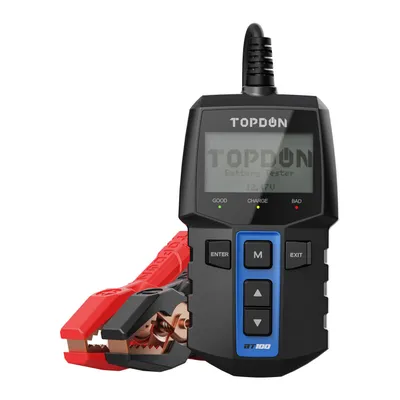
TOPDON BT100
12V batteries; 12V systems. Conductance.
Core DIY 12V battery + cranking + charging. Skip this model if your required voltage, chemistry, test method or reporting output is absent from its specification.
View capabilities and limitations →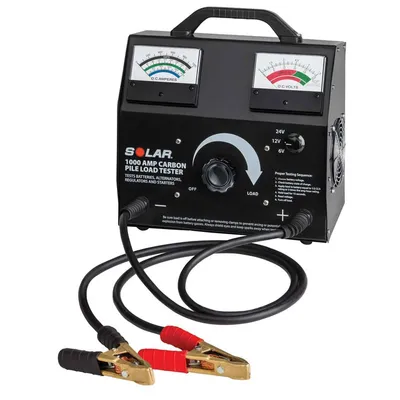
SOLAR / Clore 1876
6/12/24V batteries; 6/12/24V systems. Carbon pile.
True carbon-pile 6V/12V/24V tester. Skip this model if your required voltage, chemistry, test method or reporting output is absent from its specification.
View capabilities and limitations →Related questions
Sources and checked date
Sources checked:
- Midtronics: Which battery test technology is right for you?
Conductance, load testing and reserve-capacity testing are distinct methods
This is a source-based explanation, not our hands-on testing. Capabilities do not establish merchant availability, price or vehicle compatibility. Stop work and seek qualified help if leakage, swelling, unusual heat, odor or smoke is present.
The test method is a hard requirement, not an upgrade label
A conductance-derived CCA estimate is not a carbon-pile load test. Choose true load only if the job requires that method. Conversely, a load-only instrument is not automatically a substitute for battery, cranking and charging coverage.
Figure out what you need to test
Start with what happened and what you need to check. You may already have a suitable tool, or prefer to have a shop inspect the car.
See what to check →If you need equipment
Battery health — Choose the link to see matching testers. You can change or clear these filters at any time.
Show matching testers →