What changes the decision
Check the settings as well as the result. A wrong battery type or rating can affect the report; it is not a reason to buy a replacement battery.
Separate the questions
| Report field | Question it answers | Do not treat it as |
|---|---|---|
| Manufacturer verdict | What this model concluded under this setup | A guarantee that the car will start next time |
| Rated / measured CCA | Battery’s rated starting current / tester’s estimate | Values you can swap when setting up the tester |
| SOH / SOC | Health indicator / charge-state indicator | Percentages to average into one score |
| Voltage / resistance | Electrical readings under recorded conditions | A standalone remaining-life forecast |
Start with the report header, not the biggest percentage
The MDX-655P manual asks for battery type, rating system and rating before producing its decision. Keep these fields with the result. A photo cropped down to a single SOH value removes information needed to interpret it.
Primary source: Midtronics MDX-655P official manual
A good report can still leave a different question unanswered
If your question is why the car repeatedly fails to start, a battery-health report is only part of the investigation. Starting and charging-system tests are separate functions. A printed report makes handoff easier but does not add those capabilities to a battery-only tool.
Battery Tester Match editorial interpretation, not a manufacturer verdict or remote fault diagnosis.
Choose a tester for the unanswered question
Battery Tester Match selects equipment from verified capabilities; it does not certify your battery from this article. If you need to investigate both starting and charging, choose those functions in the Finder. Check product capabilities separately from where you can buy it.
Battery Tester Match editorial interpretation, not a manufacturer verdict or remote fault diagnosis.
Choose the next step
Find a tester for battery and system checks →This prefill selects test functions, not a battery verdict or an affiliate-sponsored ranking.
Choose battery and alternator test coverage →A practical check sequence
- Keep the test header with the verdict. Record model, selected chemistry, rating standard and rated value so another reader can reproduce the setup.
- Put rated CCA and measured CCA in separate columns. Do not replace the rating with the observed estimate; the next test would use a different reference.
- When the report and symptoms disagree, identify what was not tested: battery condition, the starting event, the charging system or the parked-discharge complaint. Take the complete report to the next check.
If another measurement would answer the question
First check the tester model, rating standard and measurement conditions. A new tool is optional; extra reporting features are useful only if you need to retain or share the result.
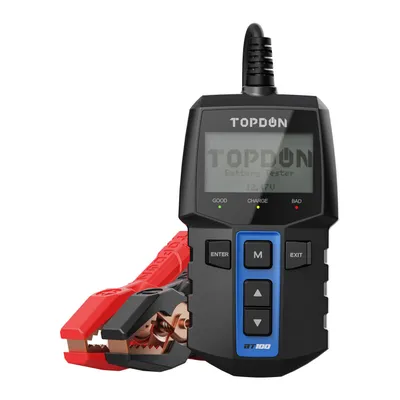
TOPDON BT100
12V batteries; 12V systems. Conductance.
Displays supported12V test results on a handheld device. No documented report export or printer.
View capabilities and limitations →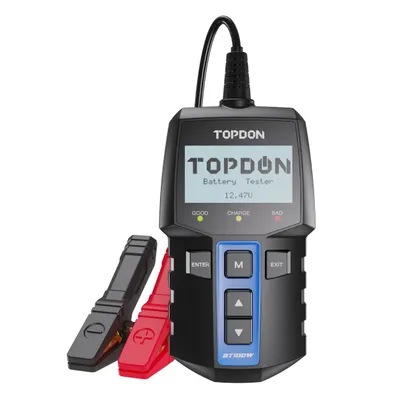
TOPDON BT100W
12V batteries; 12V systems. Conductance.
Adds an app-reporting route when a shareable record matters. Confirm the app, device version and phone requirements; the report does not prove a fault.
View capabilities and limitations →Related questions
Sources and checked date
Sources checked:
- Midtronics MDX-655P official manual
Battery-test setup and model-specific decision messages, pp. 11–12; system tests, pp. 13–14
- Midtronics: Why did every battery test result change?
Recent charging, vehicle location and input settings affect repeatability
This is a source-based explanation, not our hands-on testing. Capabilities do not establish merchant availability, price or vehicle compatibility. Stop work and seek qualified help if leakage, swelling, unusual heat, odor or smoke is present.
Read the exact verdict before the percentage
Keep the model, chemistry setting and known rating with GOOD, RECHARGE or REPLACE. An isolated CCA, SOH or resistance value does not identify a fault. If those inputs are missing, clarify the setup before treating a repeat reading as stronger evidence.
SOH and SOC: read health and charge together
SOC concerns charge; SOH concerns health-related performance. VARTA distinguishes both when discussing start-stop battery assessment. A handheld tester’s SOH percentage is not proof that it measured every aspect of health. Read its model-specific meaning with the verdict and settings.
| Report pattern | Question still open | What to check next |
|---|---|---|
| Charge indication is low, health indication looks stronger | Was the charge-and-retest instruction completed? | Charging history, full model-specific verdict and repeat conditions |
| Charge indication looks stronger, health indication concerns you | What supports the health interpretation? | Correct rating/type, starting symptoms and the complete report |
| Percentages changed after a setup change | Are these comparable tests? | Same instrument, reference standard, battery type and measurement conditions |
| Only two percentages, no instrument or rating details | What do those percentages mean on this model? | Find the tester model and settings before deciding what the numbers mean |
VARTA: Testing the battery — step-by-step — Manufacturer distinction between SOC and SOH. The report-pattern table is Battery Tester Match editorial reasoning, not VARTA thresholds or a new engine rule. Checked:
Figure out what you need to test
Start with what happened and what you need to check. You may already have a suitable tool, or prefer to have a shop inspect the car.
See what to check →If you need equipment
Battery health — Choose the link to see matching testers. You can change or clear these filters at any time.
Show matching testers →