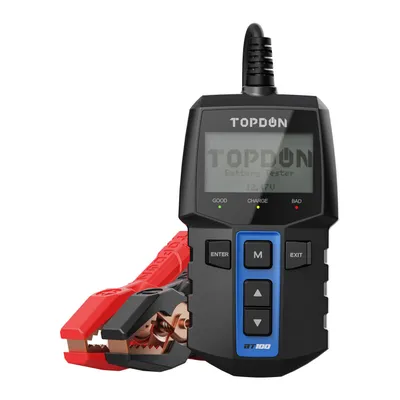
TOPDON BT100
12V batteries; 12V systems. Conductance.
A handheld12V check without paying for paper output. Does not establish the cause of a recurring drain.
View capabilities and limitations →Problem → test requirement → right tool
One dead battery does not necessarily mean you need a replacement. Once the car is safely running again, note what caused the discharge if you know, whether it was charged or tested afterward, and whether starting trouble returns.
| Situation | What matters | Next check |
|---|---|---|
| Known lights-left-on event; car recovered | Trigger, later charging and the next start are three separate facts | Reassess the battery under the device/vehicle instructions; do not buy by event count |
| No clear trigger; no report yet | The cause remains unknown even if the next start succeeds | Use the next-check Router before choosing equipment |
| A report asks for recharge or retest | Exact tester model and wording, not just the word GOOD | Read the model-specific verdict guide before treating the test as complete |
| Another discharge or slow start follows | A new recurrence changes the question | Move to the repeated-discharge or slow-crank article, rather than repeating the one-off assumption |
A known one-off trigger and an unexplained recurrence lead to different next checks. Recovery is an event, not a battery-health verdict.
The following is our editorial interpretation, not a remote fault diagnosis or hands-on test report.
Record the discharge trigger if known, the charging or inspection performed afterward, and the next starting observation. Leave unperformed checks marked unknown. The purpose of this record is to stop a successful recovery being mistaken for a completed battery assessment; it is not a fault-finding procedure.
Interstate describes several causes of discharge, so the event itself does not isolate one failed part. If you have a test report, the MDX-655P manual illustrates why the exact wording matters: a request for charging and retesting still leaves a further assessment to do. That example is model-specific, not a translation rule for every tester.
A battery-health check and a starting-system check are different requirements. Start with the question you still need answered. If no symptom has returned, this article does not create a need to buy a tester; if slow starting returns, explicitly add that requirement. Inspection is also a valid route when you do not want to perform a test.
Recovery is not proof of full charge. Do not deliberately switch off in an unsafe or remote place just to test whether it starts again; arrange the next safe stop and inspection first.
| After recovery | Next action | What not to assume |
|---|---|---|
| The engine runs after assistance | Record the trigger and arrange appropriate charging/inspection | Do not promise a full recharge after a fixed driving time |
| It stalls, warning lights appear or restarting is unreliable | Stop making repeat-start experiments | Seek vehicle-side inspection in a safe location |
| A later report looks reassuring but the problem returns | Keep the report with the recurrence timing | The charging system or parked consumption may still need investigation |
Use the battery, vehicle and charger manuals for any charging or recovery procedure. Do not idle in an enclosed space, or use a running-voltage reading as a battery-health verdict. Once conditions are suitable for measurement, keep the tester model, selected rating and the time since charging or driving. Add the actual observations to the decision flow; the article does not force CHARGE, REPLACE or any other result. Suspected freezing, leakage, swelling or smoke takes priority over restarting or testing.
Addendum sources checked: . The original article’s source date is retained separately.
One flat battery does not by itself decide replacement. If measuring is useful after safe recovery, choose battery-health and system checks that match the vehicle.
12V batteries; 12V systems. Conductance.
A handheld12V check without paying for paper output. Does not establish the cause of a recurring drain.
View capabilities and limitations →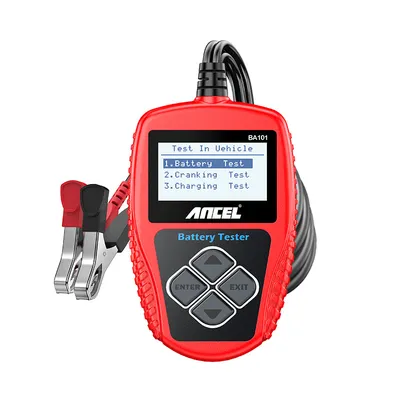
12V batteries; 12V systems. Electronic analyzer.
A12V battery/system option when PC reporting is useful. No verified24V system or actual24V battery capability.
View capabilities and limitations →Start with what happened and what you need to check. You may already have a suitable tool, or prefer to have a shop inspect the car.
See what to check →Battery health — Choose the link to see matching testers. You can change or clear these filters at any time.
Show matching testers →Manufacturer discussion of discharge causes, including vehicle use and electrical loads. It does not identify the cause in an individual vehicle.
Correct battery type/rating and measurement context; not a universal replacement threshold.
Model-specific battery decisions on printed page 12 and separate starter/charging tests on pages 14–15. Not a verdict dictionary for other testers.
Follow the vehicle, battery and equipment manuals. Stop work for leakage, swelling, unusual odor, heat or smoke. A battery-test voltage rating is not a vehicle-system voltage rating.