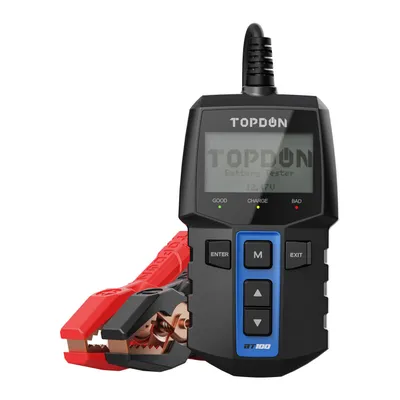
TOPDON BT100
For supported 12V battery and system checks read on the handheld screen.
No paper report or app export; extra output hardware is unnecessary if you only read the result.
View capabilities and limitations →A useful pre-winter check combines visible condition, use patterns and a correctly configured measurement. A high voltage or GOOD label alone does not guarantee that the car will start through winter.
Build a comparable record before there is a breakdown: what changed, how the car is used, what was measured and under which settings. Buy equipment only if that missing check is worth doing yourself.
| Situation | What matters | Next check |
|---|---|---|
| Visible damage or unusual heat, smell or leakage | Stop the inspection and arrange safety assessment | Do not continue with charging or a tester |
| No visible abnormality but short trips or long storage | Record charging and usage context | Discuss suitable charging, then reassess if needed |
| Measurement available | Keep model, conditions, selected chemistry and rating | Interpret the complete report alongside starting symptoms |
In a safe parked vehicle, note new starting hesitation and recent long parking or short journeys. Check only accessible battery casing, terminal covers and visible leads for obvious damage or abnormal looseness. This is not an instruction to remove covers, disconnect the battery or tighten terminals; inaccessible or uncertain connections belong in a professional inspection. Suspected freezing, leakage, swelling, odor, unusual heat or smoke is a reason to stop, not to collect another reading or begin charging.
Source context: JAF: discharge causes, symptoms and inspections (Japanese) · Midtronics: diagnostics before connecting a tester · AAA: battery safety — protecting yourself and your car
Write whether the engine was off, recently running, recently charged or currently running. Charging control and vehicle type affect the context. An isolated reading cannot establish remaining starting capacity or prove a charging-system fault. Do not compare a fresh charging reading with a resting value as if the conditions were equal.
Source context: VARTA: testing the battery step by step
Use the supported battery chemistry and rating standard. Rated CCA must come from a reliable label or manufacturer record; a JIS case code is not a numeric CCA input. Keep measured CCA, SOH, SOC and internal resistance with the exact tester model and verdict. None is a universal replacement threshold or a prediction of years remaining.
Source context: Midtronics: diagnostics before connecting a tester · VARTA: testing the battery step by step
When charging is appropriate, follow the battery, vehicle and charger manuals rather than a generic current or duration. Recheck under the instrument’s stated conditions. Persistent symptoms, repeated discharge or warning lights call for a workshop, even after a reassuring battery-only result. A written record is useful; this site does not claim to save it on a server.
Source context: GS Yuasa: charging and maintenance (Japanese) · GS Yuasa: discharge, battery life and post-jump inspection (Japanese)
Buying a tester is optional. These examples illustrate documented capabilities, not a performance ranking or a guaranteed fix. Check regional seller and warranty conditions on the product page.
For supported 12V battery and system checks read on the handheld screen.
No paper report or app export; extra output hardware is unnecessary if you only read the result.
View capabilities and limitations →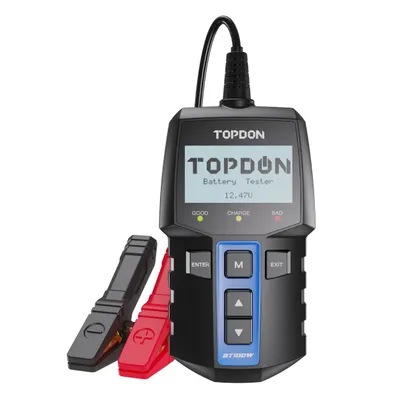
For supported 12V checks when app-based recording or sharing is actually useful.
Confirm app and phone requirements. Recording a result does not prove its interpretation.
View capabilities and limitations →Start with what happened and what you need to check. You may already have a suitable tool, or prefer to have a shop inspect the car.
See what to check →Battery health — Choose the link to see matching testers. You can change or clear these filters at any time.
Show matching testers →Sources checked: . This is also the local page editing date, not the publication date of the source.
Use patterns, discharge triggers and visible abnormalities; a general age estimate is not used as a replacement threshold.
Battery type, rating and connection context matter before interpreting a reading; not a generic repair procedure.
Separate charge state, health and battery-appropriate testing; not a universal pass/fail table.
Battery-appropriate maintenance; this guide does not prescribe a universal charging current or duration.
Post-jump inspection and discharge versus deterioration; follow the exact vehicle manual for connection procedures.
Do not jump or charge a battery suspected of freezing or leakage; seek qualified assessment.
Scope: 12V starter or auxiliary lead-acid batteries, not EV high-voltage traction or lithium-battery work. Age, SOH, SOC, CCA ratio or resistance alone does not decide replacement. Product capability evidence remains on each product page; this is source-based guidance, not our hands-on testing.