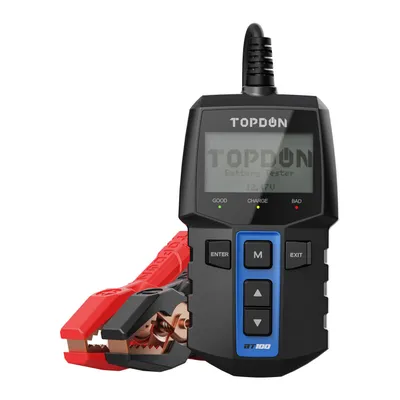
TOPDON BT100
For documented 12V battery-health and cranking checks when a safe test is possible.
Cannot identify a failed starter circuit; a no-crank can prevent a cranking test.
View capabilities and limitations →No cranking does not prove the battery has failed. A discharged battery, a connection problem, an unmet starting condition or a starting-system fault can produce similar complaints.
First name the symptom correctly. A battery tester can add battery and supported system evidence; it cannot prove a failed starter, a key fault or the cause of a no-crank from a battery verdict alone. This guide covers vehicles whose starter turns the engine. For other starting systems or auxiliary-battery concerns, follow the vehicle manual; EV high-voltage traction batteries are outside this guide’s scope.
| Situation | What matters | Next check |
|---|---|---|
| No starter rotation or only clicking | Check the vehicle’s normal starting instructions and visible warnings | If the cause is unclear, arrange battery and vehicle-side inspection |
| Starter rotates slowly | This is a slow-crank question rather than a silent starter | Use the dedicated slow-crank guide |
| Starter rotates normally but engine does not fire | Fuel, ignition or control issues may be involved | A battery-only report cannot diagnose this complaint |
Secure the vehicle and consult its manual for permitted gear position, brake or clutch operation and key recognition. Do not force a key, bypass an interlock, bridge a relay or dismantle a starter circuit. Avoid repeated attempts when the cause is unknown. Roadside danger or battery abnormalities take priority over collecting a test result.
Source context: JAF: when the start switch responds but the engine does not start (Japanese) · JAF: keys, gear position and normal starting conditions (Japanese)
Cabin electronics turning on is an observation, not proof of starting capability. A click also does not establish which part failed. Battery charge, accessible connections and vehicle-side start control remain separate possibilities. Record exactly what the vehicle did instead of replacing a component from the sound alone.
Source context: JAF: when the start switch responds but the engine does not start (Japanese) · JAF: discharge causes, symptoms and inspections (Japanese)
Some vehicles have model-specific jump-start restrictions and designated points. Follow that vehicle’s manual or use qualified assistance; this page supplies no generic cable order. Never attempt to jump or charge a battery suspected of freezing or leakage. A successful recovery still needs an appropriate follow-up check.
Source context: AAA: battery safety — protecting yourself and your car · GS Yuasa: discharge, battery life and post-jump inspection (Japanese)
If it is safe to measure, a compatible battery test may help assess the battery; a supported cranking or charging test addresses a separate function. A no-crank may prevent completion of a starting test. Keep incomplete tests incomplete, use the correct battery type and rating, and take repeated or unexplained symptoms to a workshop. A GOOD label cannot clear the entire vehicle.
Source context: Midtronics: diagnostics before connecting a tester · VARTA: testing the battery step by step
Buying a tester is optional. These examples illustrate documented capabilities, not a performance ranking or a guaranteed fix. Check regional seller and warranty conditions on the product page.
For documented 12V battery-health and cranking checks when a safe test is possible.
Cannot identify a failed starter circuit; a no-crank can prevent a cranking test.
View capabilities and limitations →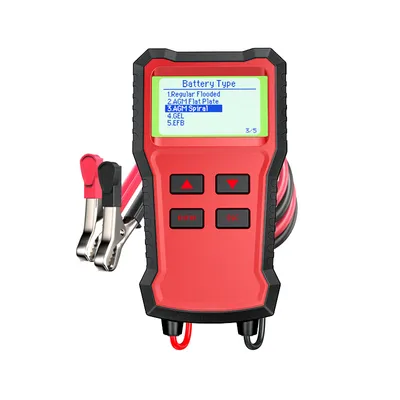
A non-affiliate alternative with battery and supported starting/charging functions.
No claim of complete fault location or vehicle compatibility. Not a reason to postpone inspection.
View capabilities and limitations →Start with what happened and what you need to check. You may already have a suitable tool, or prefer to have a shop inspect the car.
See what to check →Battery + cranking — Choose the link to see matching testers. You can change or clear these filters at any time.
Show matching testers →Sources checked: . This is also the local page editing date, not the publication date of the source.
Several start-permission and electrical causes can resemble a battery complaint; the symptom does not identify a failed part.
Check the vehicle’s starting conditions; do not bypass an interlock or force a key.
Use patterns, discharge triggers and visible abnormalities; a general age estimate is not used as a replacement threshold.
Do not jump or charge a battery suspected of freezing or leakage; seek qualified assessment.
Post-jump inspection and discharge versus deterioration; follow the exact vehicle manual for connection procedures.
Battery type, rating and connection context matter before interpreting a reading; not a generic repair procedure.
Separate charge state, health and battery-appropriate testing; not a universal pass/fail table.
Scope: 12V starter or auxiliary lead-acid batteries, not EV high-voltage traction or lithium-battery work. Age, SOH, SOC, CCA ratio or resistance alone does not decide replacement. Product capability evidence remains on each product page; this is source-based guidance, not our hands-on testing.